The Biointerfaces Institute offers state-of-the-art equipment to its constituents, the UM research community, fellow academic institutions, and industry.
You must have a FOM account to use any of the BI core equipment. Sign up for FOM HERE.
Particle Characterization
 Equipment: Mastersizer 2000
Applications and Capabilities: Laser Diffraction — particle size distribution (~0.02 μm to 600 μm)
Manufacturer: Malvern
 Equipment: Zetasizer Nano ZSP
Applications and Capabilities: Dynamic Light Scattering (DLS) — particle size distribution (~0.3 nm to 10 μm) and zeta potential measurement
Manufacturer: Malvern
 Equipment: Nanosight NS300
Applications and Capabilities: Nanoparticle Tracking Analysis (NTA) — particle size distribution (~10 nm to 1 μm), particle concentration, and fluorescence NTA with four lasers
Manufacturer: Malvern
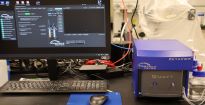 Equipment: Zetaview Evolution QUATT
Applications and Capabilities: Nanoparticle Tracking Analysis (NTA) — particle size distribution (15 nm to 1 μm), particle concentration, zeta potential, fluorescence NTA with four lasers, and colocalization measurement
Manufacturer: ParticleMetrix
Thermal Characterization
 Equipment: Discovery 2500 Differential Scanning Calorimeter (DSC)
Applications and Capabilities: Differential Scanning Calorimeter (DSC) — thermal properties of materials in temperature range -90°C to 550° C, such as melting temperature, glass transition temperature, and thermal stability with 50 sample autosampler
Manufacturer: TA Instruments
 Equipment: Nano DSC
Applications and Capabilities: Liquid Differential Scanning Calorimeter (DSC) — quantifies biomolecule thermal stability by measuring thermal changes in biomolecules, like proteins, occurring during structural changes in temperature range -10°C to 130°C with 96 well autosampler
Manufacturer: TA Instruments
 Equipment: Discovery 5500 Thermal Gravimetric Analysis (TGA)
Applications and Capabilities: Thermal Gravimetric Analysis (TGA) — degradation behavior of materials in temperature range Room Temperature to 1000° C with 12 sample autosampler
Manufacturer: TA Instruments
 Equipment: Nano ITC
Applications and Capabilities: Isothermal Titration Calorimeter (ITC) — quantifies enthalpy or entropy of reactions, for example, protein-protein interactions, to determine binding constant (Ka) and reaction energy properties in temperature range 2°C to 80°C with Gold Low Volume Cells
Manufacturer: TA Instruments
Materials Characterization
 Equipment: J-815 Circular Dichroism (CD) spectrometer
Applications and Capabilities: Circular Dichroism (CD) — chiral materials or secondary structures of proteins in range 163 nm to 900 nm with Peltier temperature stage
Manufacturer: Jasco
 Equipment: J-1700 Circular Dichroism (CD) spectrometer
Applications and Capabilities: Circular Dichroism (CD) — chiral materials or secondary structures of proteins with near IR detectors in range 163 nm to 2500 nm
Manufacturer: Jasco
 Equipment: Circularly Polarized Luminescence spectrometer (CPL-300)
Applications and Capabilities: Circularly Polarized Luminescence (CPL) — excited chiral materials characterization in range 250 nm to 850 nm
Manufacturer: Jasco
 Equipment: IR-Tracer100 Fourier-Transform Infrared (FTIR)
Applications and Capabilities: Fourier-Transform Infrared (FTIR) — materials characterization in the infrared in range 400 to 4000 cm-1 (standard detector) or 700 to 5000 cm-1 (high sensitivity detector) using transmission, Attenuated total reflectance (ATR), or grazing angle
Manufacturer: Shimadzu
 Equipment: Porosimeter Autopore V (Model: 9620)
Applications and Capabilities: Mercury intrusion porosimetry — material porosity, pore size distribution, and pore volume(pore size ~0.003 μm to 500 μm)
Manufacturer: Micromeritics
 Equipment: FluoroMax Plus spectrofluorometer
Applications and Capabilities: Fluorescence: fluorescent materials characterization with near IR detector in range 185 nm to 1550 nm, fluorescence (TCSPC) and phosphorescence lifetime, integration sphere for quantum yield, polarizers for anisotropy, and Peltier temperature stage
Manufacturer: Horiba
 Equipment: OpenSPR-XT surface plasmon resonance (SPR)
Applications and Capabilities: Surface plasmon resonance (SPR) instrument that can perform automated label-free interaction analysis of biomolecules with two 96 well plate autosampler
Manufacturer: Nicoya
Training Requirements for Core Equipment
Training for each piece of equipment is required. Sign up for training in FOM.
Sign Up for FOM
You must have a FOM account to use any of the BI core equipment. Sign up for FOM HERE.
Guidelines for Publications and Acknowledgments
Publications with results obtained at the Biointerfaces Institute Nanotechnicum may state “The authors acknowledge the financial support of the University of Michigan College of Engineering, the College of Pharmacy, Dental School and the Medical School and the Biointerfaces Institute for use of the instruments and staff assistance.”
Questions?
Contact Sarah Spanninga [email protected]